Tournemant rules
Overview
These rules cover:
- tournament structure
- fight rules
- code of conduct and penalties
1. Competition rules
1.1 General rules
Each category consists of two phases: the qualification one and the finals. The rules of fights are similar at both phases.
1.1.1 The qualification phase
- The qualification phase is run in a sort of Swiss system. All the participants begin with the same points (hit-points) at this phase. The exact number of these points will be calculated depending on the participants number.
- Fights lasts till one of fighters loses 5 (or 6) points, or till the actual time (90 seconds) is over;
- The participants who lost all their hit-points are withdrawn of the tournament even if it happened in the middle of a fight;
- Pairs for the first round are seeded randomly.
- Pairs for all the next rounds are set in such a way that in any pair fighters have a similar or close enough number of points.
Note: as swiss system prioretizes matches between participants with close rating (HP) you can have repeated fights, especially if there are not very many fighters.
- If the number of participants is odd when the tournament begins, then one random fighter gains technical win with the score 0:-6. In the next rounds the technical win will be given to the participant with the lowest score;
- The qualification phase lasts till there will be no more than 4 fighters. At that moment, 4 top fighters will proceed to the finals. If 3 or less fighters have positive points at the end of the round, places are assigned with respect to the negative points, among the participants of the last round. 1 and 2 places will fight in the final; 3 and 4 places will fight for the 3rd place. If some of the fighters left have the same rating, they will have additional round of tie-breakers with the same rules, till 5 points for the fight.
1.1.2 The finals
The finals are two fights - for 1st and 3rd places. The fight lasts until one of the participants loses 10 hit points or for 2 minutes of time. If both lose it at the same exchange, or the score is equal at the end of time, an additional round for 2 points and 30 seconds is conducted. If the winner is not assigned then, we conduct an additional round with a 0.5 points handicap assigned by a coin flip.
1.2 The rules of fights
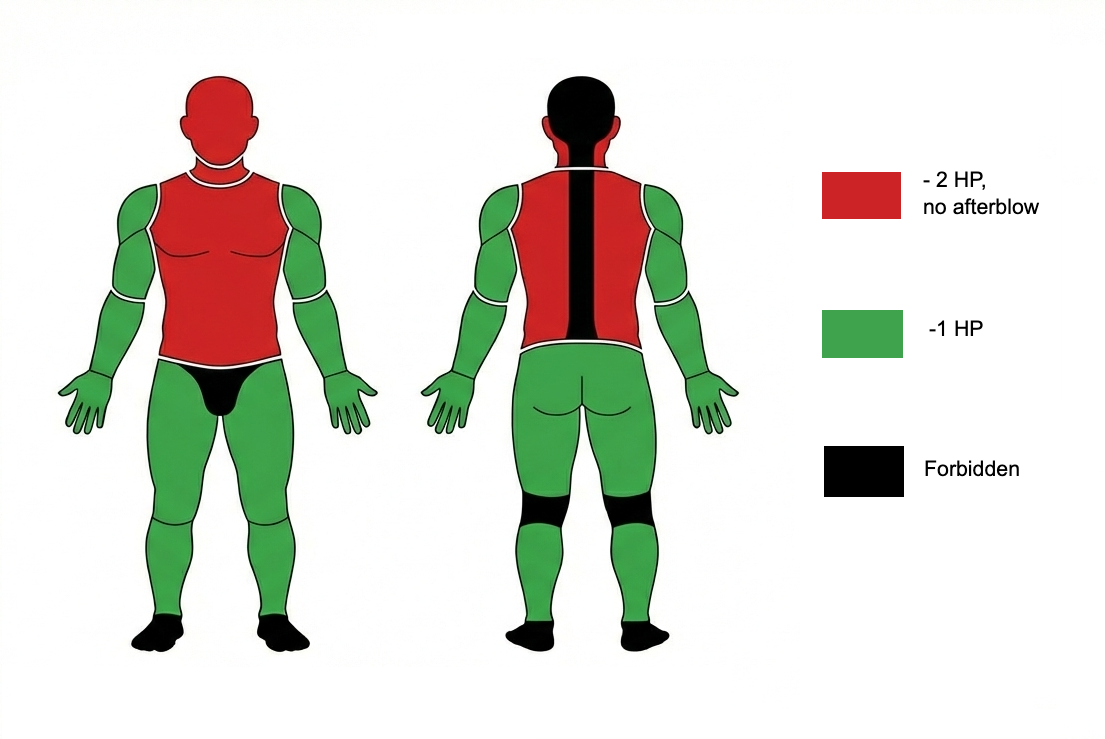
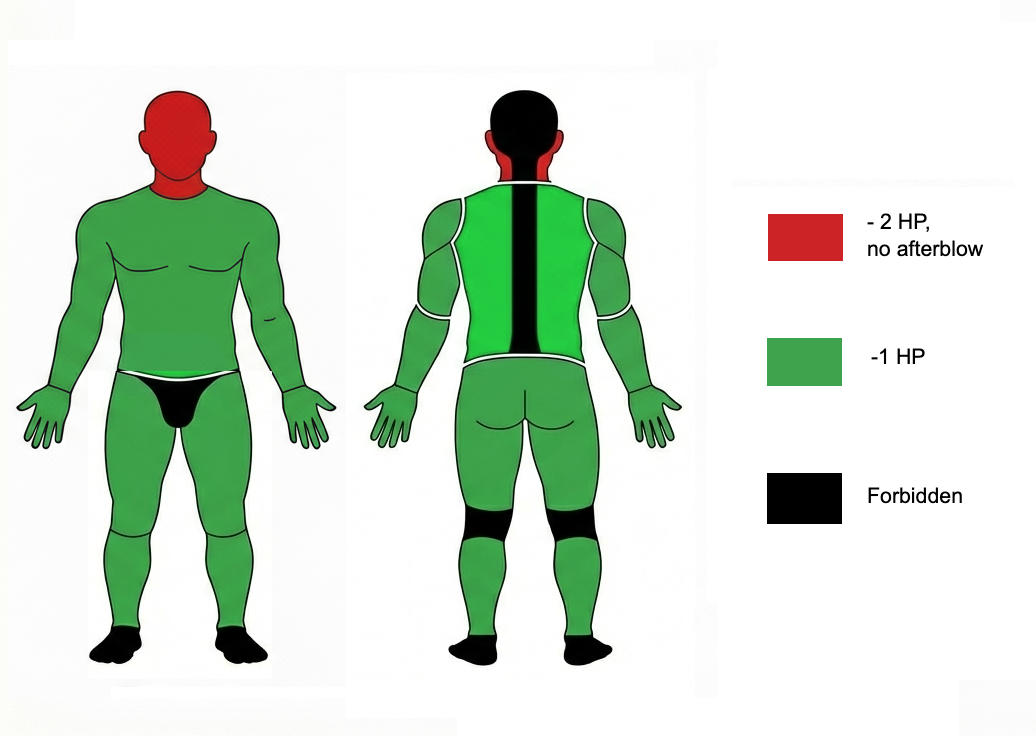
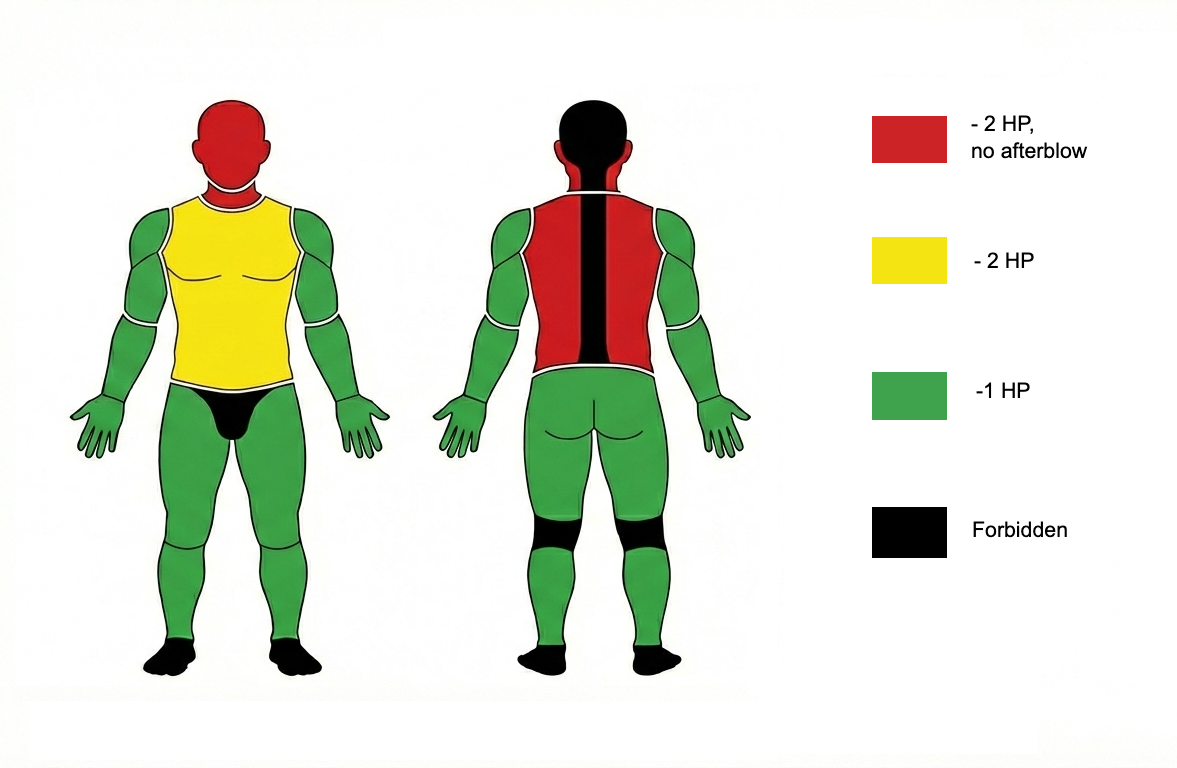
- Any cuts/thrusts performed to the head or torso take 2 points from the opponent. The only exceptions are cuts performed with sideswords (category Sword and buckler): they take 1 point from the opponent.
- Any cuts/thrusts performed to legs take 1 point from the opponent;
- Any qualified slices take 1 point from the opponent;
- Any cuts performed by the back of the sabre or the flat of any blade take no points;
- Doubles take points (according to the target areas) from both fighters;
- Thrusts to the torso and all effective attacks to the head (including slices) have a stopping effect and after blows performed after them will have no result;
- Any other after blows take points from opponent as if they were just qualified attacks according to the target areas (i.e. the after blow performed to a head will take 2 points, and the after blow performed to knee will take only 1 point);
- Allowed special tecnhiques:
- Grabbing opponent’s arms of body, without arm locks or throws, does not grant points. Wrestling is stopped after 3 to 5 seconds, or if dangerous situation occurs;
- Demonstration of pommel strikes to the mesh of the mask, takes 1 point from opponent, stopping action;
- Forbidden zones: back of the head, spine, back of the knees, feet;
- Explicitly forbidden actions: strikes with the buckler, sword guard, punches and kicks, joint locks, throws;
- Weapon loss takes 1 point from the fighter, except if the weapon was lost after thrust for the safety reasons;
- Falling takes 1 point from the fighter except situations when the falling is a part of technical action.
- If two actions happen at the same time (i.e. losing the weapon and getting strike to the head) the HIGHER score is applied;
- Unintentional leaving the fighting area with both legs will take 1 point from the fighter.
2. Rights and duties of fighters and seconds
The fighter can have a second (cornerman), who can advise the fighter between bouts and substitute the fighter in filing the challenges. Misbehavior of the second can be judged as of the fighter himself.
2.1 The fighter has right to:
- Ask the referee to repeat the fencing bout description
- Acknowledge a valid attack to himself, or discard an attack to his opponent.
- This is not counted as a challenge
- The referee has the final word on the exchange result, but should take this acknowledgement into consideration
- Challenge on the referee’s decision or points assignment
- The challenge should be called right after the decision
- The challenge is addressed to the head referee of the area, specifying the reason. Then the judges gather to discuss the challenge and make a new decision
2.2 Allowed reasons for the challenges are:
- Mistake in the fencing phrase analysis
- Mistake in qualification of the attacking or defensive actions
- Mistake in recording of the results by secretary
Other reasons of the challenges are not valid and can’t be called
2.3 Fighter obligations
- By submitting the application to the tournament, the fighters confirm that they have read, understood, and agree to respect the tournament rules
- The fighters should arrive at the tournament venue not later than the registration for their category ends. We can’t guarantee participation of the late fighters.
- The fighter should prepare for the fight in advance. The fighters are given 60 seconds to enter the area after the fight announcement. If a fighter fails to do so, the fight is transferred 2 fights forward. On the second failure, the present fighter is awarded technical victory.
- After the fight, fighters should arrive at the secretary to confirm that the results are recorded correctly.
3. Refereeing regulations
The referee crew of an area consists of:
- the referee (head judge) of the area
- corner (assisting) judge
- secretary of the area
- video replay operator (optional)
3.1 Referee crew duties
- The referee calls the participants to the area and checks their equipment
- The referee leads the conduct of the match with voice commands and gestures.
Typical commands:
| Command | Description |
|---|---|
| Come to the area - “Name 1”: red, “Name 2”: blue | invitation to the fight |
| Next fight - “Name 1”, “Name 2” | signal for preparation to the next fight |
| Salute! | signal for the fighters to greet each other, judges and spectators |
| Ready? | request for confirmation |
| Fight!/Fence! | signal for the beginning of a bout. The timer is started at the signal |
| Stop! | signal to stop the fight. The fighter is interrupted at the signal |
After the “stop” command, the referee describes the fencing phrase. After the description, the decision is announced:
- Minus 1(2) points Red, Minus 1 (2) points Blue
- No exchange (means that there were no qualified actions before stop command)
- Unclear exchange, no decision (means that judges can’t reliably call the result and thus discard this exchange)
- “Final score <red: X, blue: Y>, winner <red/blue>” - signal for the finish of the match and the result.
Only the referee gives vocal commands at the area, except for the safety reasons.
3.2 Corner judges signals
Corner judges follow the actions of both fighters, including successful attacks, tempo and the violations. They use the following signals to describe the bout:
For the side judge signals refer to Flag signals
3.3 Secretary duties
The secretary of the area:
- Uses a laptop or a phone with HEMAGON to measure time and keep the protocol;
- All the changes are made by the command of the referee, and only after the command;
- Announces for the referee 15 seconds before the time end;
- Calls the names of the fighters for the next fight.
3.4 Regulations for the judges’ council and decision
The referee gathers the side judge and (optional the fencers) and asks the questions about the fencing phrase description, the judges answer only “yes”, “no” or “refrain/ no opinion”.
The question may consider:
- tempo (lead) of one of the attacks
- qualification of one of the attacks
- sector of the attack
And should be asked by the form:
- Call the direction of the action (“From red fencer…”)
- Call the action (“cut/thrust/parry”)
- Call the questionable matter (“Is it qualified?” , “Is the target valid?”)
According to the answers, the referee decides the results.
4. Penalties
There are 4 levels of the penalties
- Warning 🟨, (yellow card), is given for an accidental or mild misconduct, is recorded in the protocol by the secretary, and does not affect the results;
- Penalty point 🟥, (red card), is given for the second or subsequent case of mild misconduct, or a severe misconduct, and takes 1 point from his score; Also, the actions of the carded fighter in the exchange are discarded.
- Technical loss ⬛, (black card) is given for critical misconduct or multiple lesser violations, and leads to the loss with count 0-5 in the fight
- Disqualification from the tournament and the event may be issued in case of severe and malicious misconduct by the joint decision of the event organizers after the meeting.
For the proper enforcement of this system all the penalties are cumulative, i.e. yellow and red cards remain in force until the event ends. The third red card or the second black card automatically mean a disqualification from the tournament.
Violations table:
| Violation | First time | Second time | Subsequent cases of the same violation |
|---|---|---|---|
| Proticol violation • No salute on arrival at the area • No handshake after the end of the fight • Leaving the area before the results were announced • Intentional leaving the ground during the fight • Arriving at the area without referee’s command • Attacking before “FIGHT” command or after “STOP” command • Not being present at the fighting area a minute after being called • Arguing with the judges outside of regulated challenge form | 🟨 | 🟨 | 🟥 |
| Self-endangerment • Exposing the forbidden areas to the opponent • Exposing the back to the opponent •Fighting with inadequate or damaged gear • Taking the gear elements off before STOP command | 🟨 | 🟨 | 🟥 |
| Endangering opponent • Attacking of the forbidden areas • Excessive force use and/or bad weapons control • Striking with anything but the weapon blade • Wrestling except for specifically allowed • Throwing weapon • Other actions threatening safety, on referee’s decision. | 🟨 | 🟥 | 🟥 |
| Severe misconduct • Refusal to follow the instructions of the referee • Public swearing | 🟥 | 🟥 | ⬛ |
| Bad sportsmanship • Refusal to begin/continue the assigned fight except for medical reasons • Fixed match (intentional loss to promote other participant) | ⬛ | ⬛ * | ⬛ * |
| Violation of public behavior • Presence at the venue under alcoholic or drug influence • Criminal offence | ⬛ * | ⬛ * | ⬛ * |
- can lead to immediate disqualification from the event
In case of intentional or severe violation, it can be penalized more severely than listed in the table, by the decision of the head referee of the tournament.
Any other violations which are not explicitly listed here can be addressed and penalized by the referee of the area with respect to the spirit of the rules and good sportsmanship.
Injuries and withdrawal from the tournament
In case of injury, the organizers can give the fencer a break of maximum 10 minutes for medical help and recovery. If after this period the participant is unable to continue the fights, the head referee of the event decides the withdrawal from the competition.
The medical crew of the tournament has the right to suspend the participants from the tournament in case of risk for their health, even if the participants want to continue fighting.